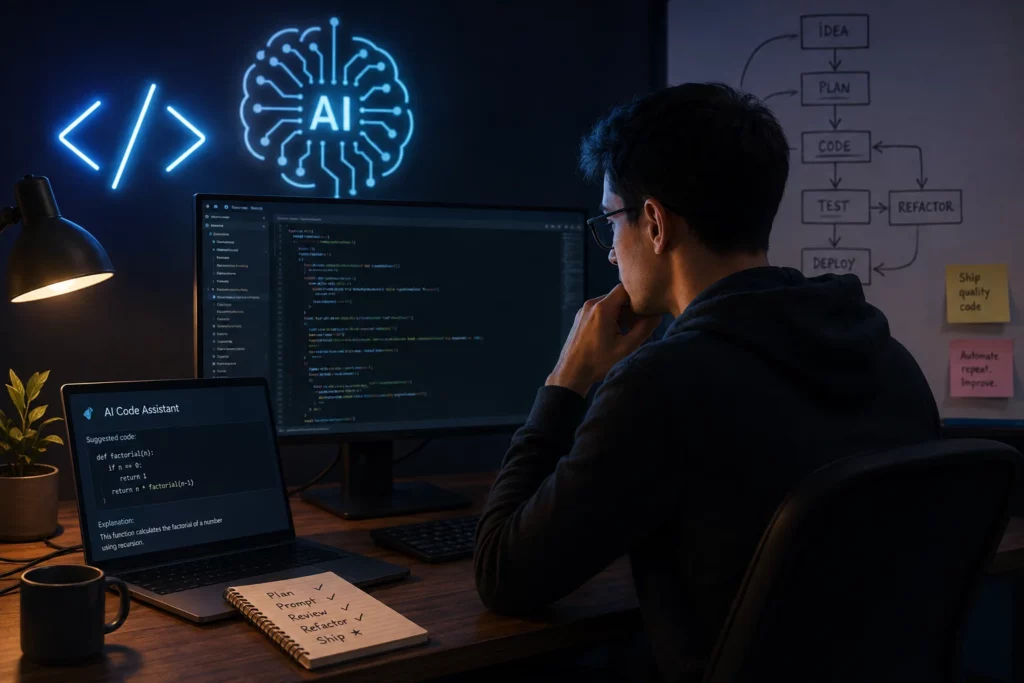
A developer today can describe a bug in plain English and watch an assistant suggest a fix before the ticket is even finished. That kind of moment barely existed five years ago. AI in programming has moved from novelty to daily habit, generating code, explaining unfamiliar functions, catching bugs, and suggesting improvements almost as fast as someone can ask.
GitHub Copilot and similar tools are no longer experimental add-ons — they sit inside everyday development workflows at companies of every size. But as these agents grow more capable, they are also raising harder questions: about security, code quality, the skills developers still need, and what the job itself will look like in a few years.
None of this is really about replacing human coding with automation. It is about changing how developers spend their time, and that shift brings real opportunity alongside real risk that businesses and developers alike need to understand before they lean in too far.
How AI in Programming Is Reshaping the Developer’s Day
Traditional software development involves a wide range of activities, including planning, coding, debugging, testing, documentation, code reviews, and maintenance. AI can assist with many of these tasks.
Modern AI coding tools can generate code from natural-language instructions, suggest completions while developers type, explain unfamiliar code, create tests, and help identify potential problems. Some newer agentic systems can go even further by planning tasks, modifying multiple files, running tests, and interacting with development tools.
This represents a significant shift in the developer workflow. Instead of treating programming as purely a process of translating ideas into code, developers can increasingly describe what they want and use AI to help implement the solution.
GitHub‘s research has found significant productivity benefits from AI-assisted development, although productivity is broader than simply producing more lines of code.
Where AI Is Actually Helping Developers
Faster Software Development
One of the biggest advantages of AI in programming is speed.
AI assistants can generate boilerplate code, write repetitive functions, produce documentation, and provide suggestions without requiring developers to repeatedly search through documentation or online forums.
In a controlled GitHub study involving professional developers, the group using GitHub Copilot completed a programming task significantly faster than the group without it. The study reported a 55% reduction in completion time for the specific task tested.
For businesses, faster development can potentially mean shorter development cycles and the ability to deliver new products and features more quickly.
However, speed should not become the only measure of success. Software still needs to be reliable, maintainable, secure, and fit for purpose.
Making Programming More Accessible
AI could also lower some of the barriers to software development.
Someone learning Python, JavaScript, Java, or another programming language can ask an AI assistant to explain unfamiliar concepts, provide examples, or help identify why a program is failing.
This creates a more interactive learning experience. Instead of simply searching for an answer, learners can ask follow-up questions and receive explanations based on their specific problem.
GitHub has reported that developers see AI coding tools as an opportunity to improve their programming skills. In one survey, 57% of respondents said AI coding tools helped them develop their coding-language skills.
AI therefore has the potential to become both a productivity tool and a learning companion.
Better Debugging and Testing
Debugging can consume a significant amount of a developer’s time. AI can help by analysing error messages, examining code, suggesting possible causes, and proposing fixes.
AI can also assist with generating unit tests and identifying areas of a project that may require additional testing.
This does not eliminate the need for human testing. Instead, it can help developers cover routine tasks more efficiently while allowing them to focus on difficult problems involving architecture, business requirements, and user experience.
AI-assisted code review can also provide another layer of feedback. GitHub research into Copilot Chat found that developers using the tool completed code reviews 15% faster in the study.
Where AI Coding Tools Still Fall Short
AI-Generated Code Can Be Wrong
One of the most important limitations of AI programming tools is that generated code is not guaranteed to be correct.
An AI model can produce code that looks convincing but contains logical errors, outdated approaches, inefficient implementations, or subtle bugs. This is particularly dangerous when developers accept suggestions without understanding what the code does.
The problem becomes even more important in critical systems such as financial applications, healthcare software, infrastructure, and security systems.
Developers therefore need to review, test, and understand AI-generated code rather than blindly accepting it. OWASP highlights blind trust in automatically generated code as a security concern because generated outputs can contain vulnerabilities or inappropriate configurations.
Security and Privacy Risks
AI-assisted programming introduces new security considerations.
Developers may accidentally provide sensitive source code, credentials, proprietary information, or confidential business data to AI systems. AI-generated code can also introduce insecure dependencies, weak authentication practices, or vulnerabilities that are difficult to spot.
These risks become even more significant as AI coding agents gain the ability to execute commands, install packages, access files, and interact with external systems.
OWASP‘s current guidance on secure coding with AI specifically addresses issues such as sensitive-code exposure, prompt-context leakage, supply-chain risks, CI/CD agent risks, and multi-agent security.
Businesses adopting AI programming tools therefore need clear security policies, access controls, testing procedures, and developer training.
Changing Developer Skills
AI will not necessarily make programming skills irrelevant, but it is likely to change which skills are most valuable.
Developers may spend less time writing repetitive code and more time defining requirements, designing systems, reviewing AI-generated solutions, testing applications, and solving complex problems.
This means understanding programming fundamentals could become even more important. A developer who understands algorithms, data structures, security, architecture, and software engineering principles is better equipped to recognise when an AI-generated solution is incorrect.
The future programmer may therefore be less focused on typing every line manually and more focused on directing, evaluating, and improving machine-generated work.
Where Human Developers Fit Into an AI-Assisted Future
The most realistic future is not humans versus AI. It is humans working with AI.
AI can handle many repetitive and time-consuming programming tasks, while developers provide context, judgment, creativity, and accountability. This partnership could allow software teams to experiment more quickly and spend more time solving higher-level problems.
At the same time, organisations should avoid treating AI as an automatic replacement for experienced developers. AI-generated software still requires human oversight, particularly when security, reliability, compliance, and long-term maintenance matter.
As AI coding agents become more capable, the developer’s role will likely continue evolving. GitHub’s 2026 updates demonstrate this shift toward AI systems capable of planning, editing, debugging, reviewing, and using development tools across longer workflows. GitHub’s 2026 overview of agentic development
The Bottom Line for Developers and Teams
AI in programming presents one of the most significant changes to software development in decades. It can accelerate coding, assist with debugging, support learning, automate repetitive work, and help developers remain productive.
But the technology also brings real challenges. Incorrect code, security vulnerabilities, privacy concerns, over-reliance on automation, and changing skill requirements all need to be addressed.
The developers who benefit most from AI are unlikely to be those who simply generate the most code. They will be the ones who understand how to use AI effectively while retaining the ability to question its output, test its suggestions, and make informed technical decisions.
AI may be changing how software is written, but human judgment remains at the centre of building software that actually works.
Read – AI in Gaming: Opportunities and Challenges
Read – How to Use AI to Grow Your YouTube Channel
Sharing Is Caring
3 thoughts on “AI in Programming: Opportunities and Challenges”
Comments are closed.