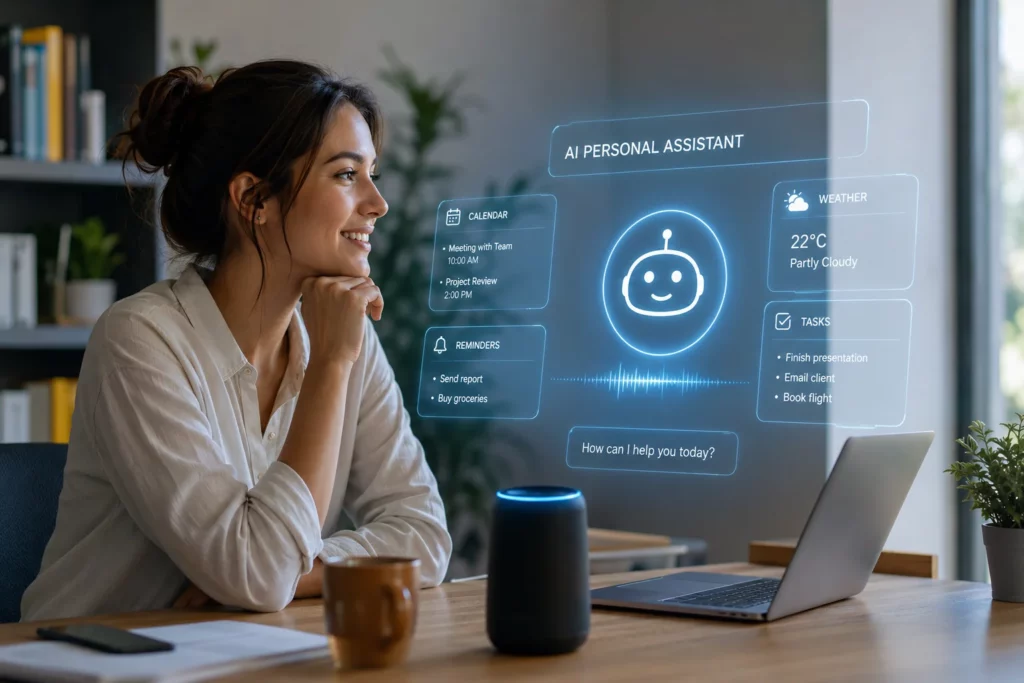
Ask Siri to handle a multi-step errand a few years ago and it usually stalled after the first step. Ask today’s AI personal assistants the same thing — summarize an email, flag the deadline, draft a reply — and there’s a real chance the job gets done without you opening another app. That shift is happening because Apple, Google and other major players have moved past simple, single-command tools and are now building AI personal assistants powered by generative AI, natural language processing and access to personal context that older tools like the original Siri and Google Assistant never had.
That leap forward opens real opportunities for consumers and businesses alike, but it also raises pressing questions about privacy, accuracy, security and how dependent people should become on the technology.
From Simple Commands to Real Conversations
AI personal assistants are moving beyond command-based interactions toward more conversational and contextual experiences. Instead of requiring users to phrase requests in a particular way, modern assistants can understand natural language and maintain context across interactions.
Apple, for example, is developing a more capable AI-powered Siri as part of its broader Apple Intelligence platform. Apple says its newer approach combines on-device processing with Private Cloud Compute for more complex requests.
Google is taking a similarly integrated approach with Gemini. Its AI assistant can interact with connected services and, depending on a user’s settings and eligibility, use information from services such as Gmail, Calendar, Photos, YouTube and other Google products to provide more personalized assistance.
This represents a major change in what consumers can expect from a digital assistant.
Where AI Personal Assistants Are Already Delivering Value
Greater Productivity
One of the biggest advantages of AI personal assistants is productivity. Instead of simply responding to individual commands, an assistant can help organize information and complete multiple steps involved in a task.
For example, a user might ask an AI assistant to summarize an email, identify important deadlines, create a reminder and prepare a response. An assistant connected to calendars, documents and other applications could potentially coordinate these activities without requiring the user to switch between multiple platforms.
This could be particularly valuable for professionals, students, freelancers and small-business owners who regularly deal with large amounts of information.
The opportunity extends beyond office work. AI assistants could help users organize travel plans, manage shopping lists, find information, schedule appointments and coordinate everyday responsibilities.
More Personalized Experiences
Personalization is another major development. Traditional software generally requires users to adapt themselves to the application. AI assistants are increasingly attempting to do the opposite.
An assistant that understands a user’s preferences, routines and frequently used applications can potentially provide more relevant recommendations and responses. Google, for instance, says its Connected Apps functionality can use information from connected Google services to personalize experiences and perform tasks for eligible users.
This could make technology feel less like a collection of separate applications and more like a unified digital companion.
However, personalization comes with an important trade-off: the more an assistant knows about someone, the more carefully that information needs to be protected.
The Risks of Giving an Assistant This Much Access
Privacy and Personal Data
Privacy is arguably the biggest challenge facing AI personal assistants.
For an assistant to provide highly personalized help, it may need access to information such as emails, calendars, contacts, location, photos, documents, browsing activity or previous conversations. Google’s current Gemini privacy documentation illustrates just how broad this information can become when users enable connected services.
The more data an AI system can access, the greater the potential consequences of unauthorized access, accidental disclosure or misuse.
Technology companies are therefore experimenting with different privacy approaches. Apple emphasizes on-device processing and says that data sent to Private Cloud Compute for supported requests is not stored or accessible to Apple.
Users, however, still need to understand what information their assistants can access and how their privacy settings work.
Accuracy and AI Hallucinations
Greater capability does not necessarily mean greater reliability.
Generative AI systems can produce incorrect information while presenting it in a convincing manner. This becomes especially problematic when an assistant moves from answering questions to taking actions.
A wrong restaurant recommendation is inconvenient. A misunderstood financial instruction, incorrectly scheduled appointment or inaccurate business email could have much more serious consequences.
The challenge becomes even greater as AI assistants gain access to external applications and tools. The National Institute of Standards and Technology (NIST) has highlighted the opportunities offered by AI agents while also emphasizing the risks associated with giving autonomous systems access to diverse data, applications and tools.
This means future assistants will need stronger safeguards, verification mechanisms and clearly defined limits on what they can do without human approval.
Security and Unauthorized Actions
An AI assistant with access to personal accounts effectively becomes another pathway into a user’s digital life.
If attackers can manipulate an assistant, steal credentials or exploit connected applications, they could potentially gain access to sensitive information or cause unwanted actions. NIST’s work on trustworthy AI similarly identifies privacy, security and system integrity as important concerns as AI systems become more capable and connected.
For this reason, future AI assistants will require robust authentication, authorization and permission systems. Users should be able to determine exactly which applications an assistant can access and which actions require confirmation.
Human Dependence
There is also a less technical concern: overdependence.
AI assistants can save time, but relying on them for every decision could weaken people’s ability or willingness to research, remember and evaluate information independently. If users begin treating AI-generated recommendations as automatically correct, errors can become harder to detect.
The best approach is therefore not to replace human judgment but to augment it. AI can handle repetitive tasks, organize information and suggest options while humans remain responsible for important decisions.
Where This Technology Is Headed
The future of personal assistants is likely to involve greater integration rather than simply better conversation. Assistants could become a central interface connecting calendars, communications, smart-home devices, productivity applications and online services.
The biggest opportunity is convenience: technology that understands what users are trying to accomplish and helps them achieve it with fewer steps.
The biggest challenge is trust.
For AI personal assistants to become genuinely useful, users need confidence that these systems are accurate, secure, transparent and respectful of personal data. Developers will need to balance capability with privacy and autonomy with human control.
AI personal assistants have the potential to become some of the most influential consumer applications of the next generation. Their success, however, will depend not only on how intelligent they become, but on whether people can trust them with increasingly important parts of their digital lives.
Read – AI in Gaming: Opportunities and Challenges
Read – AI in Programming: Opportunities and Challenges
Sharing Is Caring
One thought on “AI in Personal Assistants: Opportunities and Challenges”
Comments are closed.