Picture an NPC that doesn’t recite a scripted line but actually answers what you ask it — that shift is what’s driving AI in gaming from a decades-old background feature, quietly powering enemy behaviour, pathfinding and difficulty scaling, into something far more ambitious. Advances in generative AI and machine learning are opening doors that scripted systems never could.
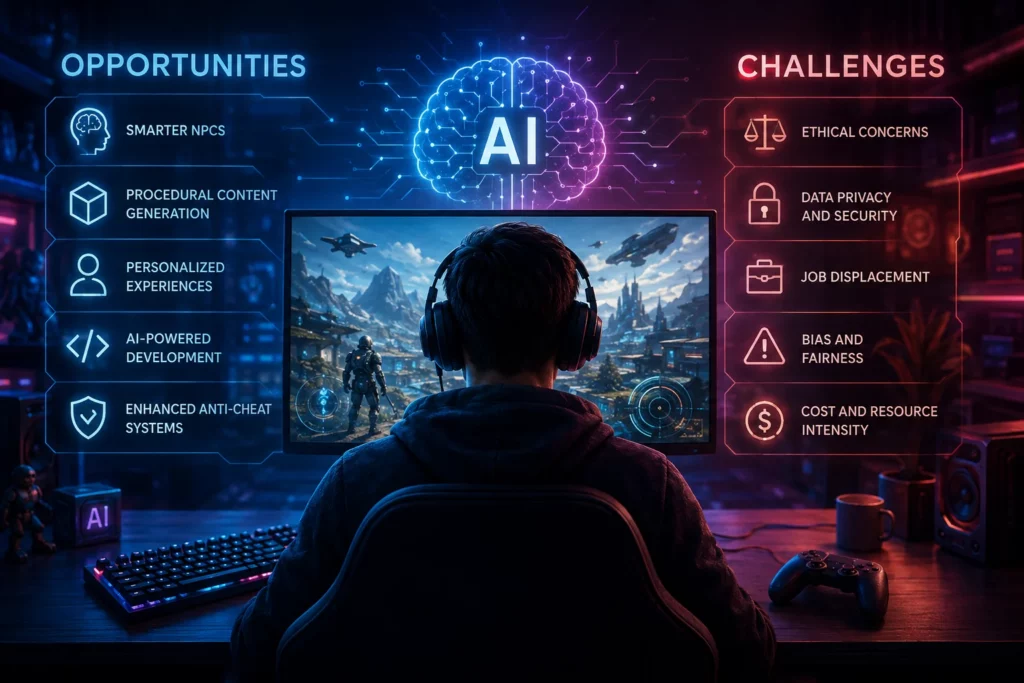
Intelligent NPCs, AI-assisted development, personalised gameplay and automated content creation are already changing what’s possible for studios large and small. Alongside those gains, though, come real questions about copyright, employment, privacy, safety and whether human creativity stays at the centre of how games get made.
Where AI in Gaming Is Already Paying Off
Smarter and More Dynamic NPCs
One of the most promising applications of AI is the creation of more intelligent non-player characters (NPCs). Traditional NPCs generally operate using predefined scripts, dialogue trees and programmed behaviours. Generative AI can potentially make these characters more responsive by allowing them to understand natural-language interactions and generate contextually relevant responses.
For example, NVIDIA’s ACE for Games technology is designed to help developers create AI-powered characters capable of natural-language conversations. The technology combines AI models for areas including speech recognition, language generation and facial animation.
NVIDIA has also demonstrated AI characters that can move beyond simple conversation. Its newer ACE autonomous game character technology explores characters that can perceive their surroundings, plan actions and respond dynamically to players.
This could make game worlds considerably more immersive. Instead of interacting with characters through a limited set of scripted responses, players could eventually have conversations and interactions that feel much more natural and personalised.
Faster Game Development
AI is also becoming a practical tool for developers. Game studios can use AI-assisted systems to support programming, debugging, prototyping, asset creation and other repetitive tasks.
Unity’s AI tools, for example, include an in-editor AI assistant built specifically around game-development workflows. The system can work with information from a developer’s project, including scenes, GameObjects, components and packages, allowing AI assistance to be integrated directly into the development environment.
This could help developers spend less time on repetitive technical tasks and more time on creative decisions. It may be particularly valuable for independent studios, where small teams often have to manage programming, design, art and production simultaneously.
AI does not necessarily have to replace developers. Instead, it can function as an additional tool that helps teams experiment, prototype and solve technical problems more quickly.
More Personalised Player Experiences
Another major opportunity is the ability to personalise games around individual players.
AI systems can analyse gameplay behaviour and potentially adapt aspects of an experience according to how someone plays. Difficulty, enemy behaviour, recommendations, missions and challenges could become more responsive to individual preferences.
For example, a player who prefers exploration could receive different opportunities from someone who focuses heavily on combat. Similarly, adaptive systems could potentially help make games more accessible by responding to different player abilities and playing styles.
The result could be games that feel less like fixed products and more like dynamic experiences that respond to the people playing them.
New Possibilities for Game Content
AI could also expand how developers approach content creation. Procedural generation has already enabled games to create large environments and varied gameplay experiences, but generative AI could make these systems more flexible.
Developers could potentially use AI to create variations of dialogue, environments, characters, animations and other assets during development or, in some cases, at runtime.
This could help studios produce larger and more varied game worlds without requiring every element to be manually created. It may also encourage new forms of storytelling in which player decisions and AI systems combine to create less predictable experiences.
The Risks Studios Still Need to Manage
Copyright and Ownership
One of the biggest challenges surrounding AI in gaming is intellectual property.
Games contain enormous amounts of creative material, including artwork, music, dialogue, character performances and software code. As developers increasingly use generative AI, questions arise over the data used to train AI models and the ownership of the resulting content.
The U.S. Copyright Office’s ongoing Copyright and Artificial Intelligence initiative examines these issues, including the copyrightability of AI-generated material and the use of copyrighted works in AI training.
In its 2025 report on copyrightability, the Copyright Office concluded that AI-assisted work can receive copyright protection where there is sufficient human creative contribution, while purely AI-generated material does not receive copyright protection simply because someone provided prompts. This distinction could become increasingly important for game studios incorporating AI-generated assets into commercial products.
The Impact on Creative Professionals
AI is also creating uncertainty for people working in the gaming industry. Artists, writers, programmers, voice actors and other professionals are increasingly considering how automation could affect their roles.
The issue is particularly significant when AI is used to reproduce a performer’s voice, appearance or other characteristics. The 2025 SAG-AFTRA Interactive Media Video Game Agreement introduced protections around AI digital replicas, including consent and disclosure requirements.
This reflects a broader industry debate: should AI primarily replace creative work, or should it help creative professionals become more productive?
The answer is likely to vary between studios and roles. AI could reduce repetitive work while allowing people to focus on higher-level creative decisions, but responsible implementation will require clear policies around consent, attribution, compensation and job security.
Privacy and Player Safety
AI-powered games can also introduce new privacy and safety concerns. Games using conversational AI may process voice recordings, text conversations and information about player behaviour.
These concerns are particularly important when games are used by children. The Federal Trade Commission’s guidance on kids and video games specifically highlights concerns about AI chatbots potentially producing harmful or dangerous responses to children.
Developers therefore need strong safeguards around AI-powered interactions. Moderation systems, privacy protections and appropriate content controls will become increasingly important as conversational AI becomes more common inside games.
Cost and Technical Complexity
Although AI can make some development tasks faster, sophisticated AI systems are not automatically inexpensive.
Real-time AI interactions can require substantial computing resources, while cloud-based models can introduce ongoing infrastructure and usage costs. Developers must also test AI-generated content carefully because AI systems can produce inaccurate, inconsistent or inappropriate results.
This means human oversight will remain essential. AI can generate content quickly, but developers still need to determine whether that content fits the game’s story, mechanics, visual style and target audience.
What Comes Next for Game Development
AI has the potential to transform almost every stage of gaming, from development and testing to character design and player interaction.
However, the most successful use of AI may not involve replacing human creativity. Instead, AI could become a powerful extension of the creative process, allowing developers to automate repetitive tasks while spending more time on storytelling, world-building and game design.
The industry will need to balance innovation with responsible practices around copyright, privacy, performer rights and player safety. Developers will also need to be transparent about how AI is used and ensure that automated systems remain under appropriate human supervision.
The future of AI in gaming is therefore unlikely to be defined simply by whether machines can create games. The more important question is how developers can combine artificial intelligence with human imagination to create experiences that are more immersive, responsive and innovative.
If that balance can be achieved, AI could become one of the most important tools in the next generation of game development—enhancing the medium without taking away the human creativity that makes gaming compelling.