Artificial intelligence has moved far beyond being a futuristic concept. In 2026, AI has become a core part of how blogs, videos, podcasts, social media posts, and marketing campaigns are created. What once required entire creative teams can now be started by a single person using AI-powered tools.
From generating blog outlines to editing videos and designing graphics, AI is dramatically reshaping the creative industry. Some people see this transformation as an opportunity for faster innovation, while others worry about originality, ethics, and the future of human creativity.
The reality lies somewhere in between.
AI is not replacing creativity — it is changing how creativity works.
The Rise of AI-Assisted Creativity
Content creation used to be highly manual. Writers researched topics, designers built visuals from scratch, and editors spent hours refining projects. Today, AI tools can automate many of those repetitive tasks.
Modern AI systems can:
- Generate article drafts
- Suggest headlines and SEO keywords
- Create social media captions
- Produce AI-generated images
- Edit audio and video
- Translate and localize content
- Repurpose long-form content into short clips
This has significantly reduced the time required to produce digital content. According to recent industry reports, businesses now use AI to accelerate workflows and improve productivity across marketing and publishing teams. (https://siit.co/blog/generative-ai-is-changing-content-creation-in-2026/50559)
For creators, this means spending less time on repetitive production tasks and more time focusing on strategy, storytelling, and audience engagement.
AI Is Democratizing Content Creation
One of the biggest impacts of AI is accessibility.
Years ago, producing high-quality content often required expensive software, technical skills, or a large team. Today, small businesses, freelancers, and solo creators can produce professional-looking work with minimal resources.
AI image generators allow users without graphic design experience to create visuals quickly. AI writing assistants help bloggers draft articles faster. Video editing platforms can automatically add captions, transitions, and voiceovers.
This democratization has lowered the barrier to entry for content creation. (https://siit.co/blog/how-generative-ai-is-changing-content-creation-in-2026/50546)
As a result, more people than ever can participate in the creator economy.
However, greater accessibility also means greater competition. Since AI makes publishing easier, audiences are now flooded with content daily. That has shifted the focus from quantity to quality.
Human Creativity Still Matters
Despite rapid AI advancement, human creativity remains essential.
AI can generate text and visuals based on patterns, but it does not possess human emotion, lived experience, or true originality. The best-performing content often combines AI efficiency with human insight.
Successful creators now use AI as a collaborative assistant rather than a replacement. AI can brainstorm ideas or create first drafts, but humans still shape the tone, personality, and authenticity behind the final product.
Many experts believe the future belongs to “hybrid creators” — people who know how to combine AI tools with genuine expertise and storytelling skills.
Audiences are also becoming more aware of overly generic AI-generated content. Readers increasingly value content that feels personal, trustworthy, and insightful.
In a world full of AI-generated material, authenticity becomes a competitive advantage.
AI Is Transforming SEO and Digital Marketing
AI is also reshaping how websites compete for visibility online.
Search engines and AI assistants are changing how people discover information. Instead of clicking through multiple websites, users often receive direct AI-generated summaries.
This means creators must optimize content not only for search engines but also for AI-driven platforms. Discussions across SEO communities highlight that modern content strategies now prioritize clear structure, topical authority, and trustworthy information. (https://www.reddit.com/r/GenAIforbeginners/comments/1rdd16z/how_is_generative_ai_changing_seo_in_2026/)
Content creators are adapting by:
- Creating more authoritative content clusters
- Adding structured FAQs and schema markup
- Focusing on expertise and originality
- Updating existing content regularly
- Writing clearly for both humans and AI systems
AI itself is also being used internally by marketers for keyword research, content planning, and audience analysis.
The result is a faster and more data-driven content ecosystem.
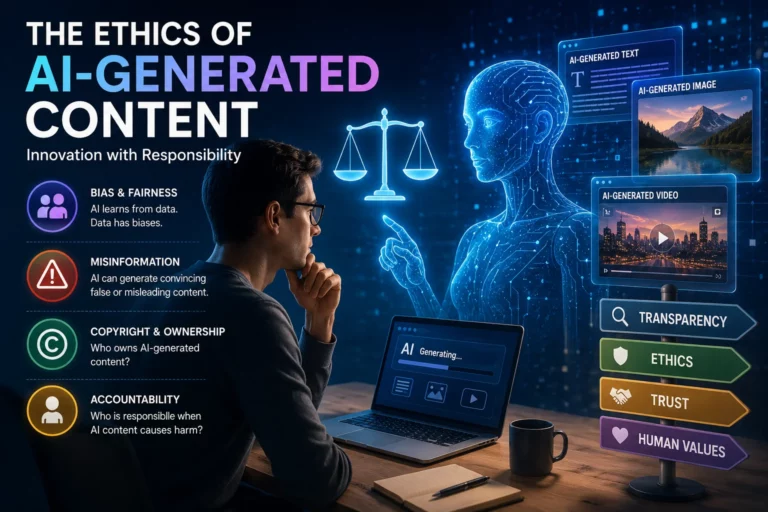
Ethical Concerns Are Growing
While AI offers incredible opportunities, it also raises serious ethical concerns.
One major issue involves copyright and ownership. Many AI systems are trained using large datasets gathered from the internet, including copyrighted works. This has sparked debates over whether AI-generated outputs unfairly rely on human-created material.
There are also concerns about misinformation and low-quality “AI slop” flooding online platforms. Critics argue that mass-produced AI content could reduce trust in digital media and overwhelm audiences with repetitive or inaccurate information. (https://www.theguardian.com/commentisfree/2026/apr/30/tax-ai-slop)
Deepfakes and synthetic influencers are another growing challenge. AI-generated personalities are already being used in marketing campaigns, raising questions about transparency and authenticity.
As AI adoption grows, governments and technology companies are under increasing pressure to establish clearer regulations and ethical standards.
The Future of Content Creation
The future of content creation will likely be collaborative rather than fully automated.
AI will continue handling repetitive production tasks such as drafting, editing, formatting, and repurposing. Meanwhile, humans will focus on creativity, emotional storytelling, critical thinking, and building trust with audiences.
Multimodal AI systems are also becoming more common. These tools can generate text, images, audio, and video from a single prompt, creating fully integrated content workflows. (https://www.genailast.com/blogs/the-future-of-ai-content-creation-trends-2026-1.php)
For creators and businesses, AI literacy is quickly becoming an essential skill.
Those who understand how to use AI responsibly and creatively will gain a major advantage in the digital economy.
AI is fundamentally changing content creation, but it is not eliminating the need for human creativity.
Instead, it is transforming the creative process itself.
Writers, marketers, designers, and creators now have access to tools that can dramatically improve speed and efficiency. At the same time, audiences are demanding more authenticity, trust, and originality than ever before.
The creators who thrive in this new era will not simply rely on AI to produce content. They will use AI strategically while continuing to offer something uniquely human: perspective, emotion, experience, and creativity.
In the end, AI may change how content is made, but human connection will remain the heart of meaningful storytelling.