

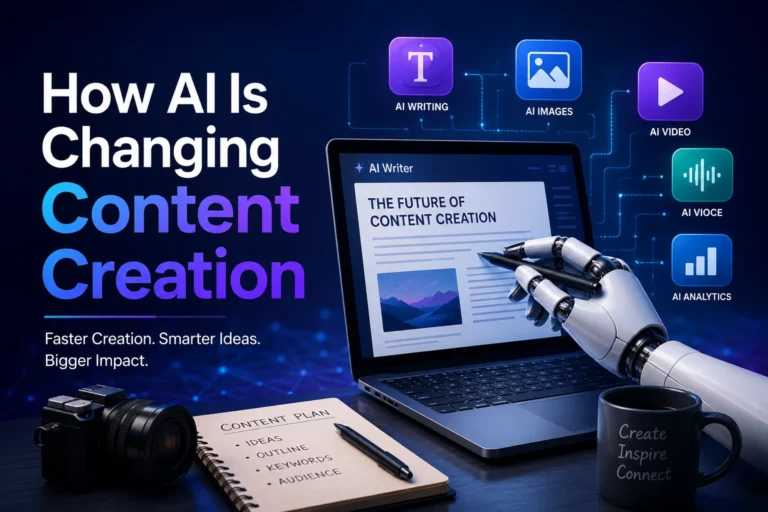
Artificial intelligence has transformed content creation at an unprecedented pace. From blog posts and marketing copy to realistic images and videos, AI tools can now produce content in seconds. While this innovation offers immense benefits, it also introduces a complex web of ethical dilemmas that society is only beginning to understand.
The ethics of AI-generated content is not just a technical issue—it is a human one. It touches on truth, ownership, fairness, and accountability. As AI becomes more embedded in our daily lives, the question is no longer what AI can do, but what it should do.
The Promise of AI-Generated Content
AI-generated content has undeniable advantages. It democratizes creativity, allowing individuals and businesses to produce high-quality material without extensive resources. It boosts productivity, enhances personalization, and enables rapid experimentation.
In industries like marketing, journalism, and entertainment, AI is already streamlining workflows. However, this convenience comes with trade-offs that cannot be ignored.
Bias: The Hidden Problem
One of the most pressing ethical concerns is bias. AI systems learn from vast datasets, many of which contain historical and societal biases. As a result, AI-generated content can unintentionally reinforce stereotypes or produce discriminatory outputs.
Research shows that these biases can manifest in various ways, including gender and racial discrimination in generated text or imagery. (https://www.computer.org/publications/tech-news/trends/ethical-concerns-on-ai-content-creation)
This raises an uncomfortable truth: AI is not neutral. It reflects the imperfections of the data it is trained on. Without proper oversight, AI-generated content can amplify inequality rather than reduce it.
Misinformation and Deepfakes
Perhaps the most alarming ethical issue is the potential for misinformation. AI can generate highly convincing fake content, including articles, images, and even videos known as deepfakes.
Deepfakes can depict people saying or doing things they never did, making them powerful tools for deception. Studies highlight how such content can be used for manipulation, blackmail, or spreading false narratives. (https://link.springer.com/article/10.1007/s13347-021-00459-2)
Recent real-world incidents show how AI-generated deepfake videos are already being used in scams and misleading advertisements, blurring the line between reality and fiction. (https://www.theverge.com/ai-artificial-intelligence/920351/ai-celebrity-deepfake-ads-tiktok-copyleaks)
In an era where information spreads rapidly, the ability to fabricate convincing content at scale poses a serious threat to public trust.
Copyright and Ownership: Who Owns AI Content?
Another major ethical challenge is intellectual property. Traditional copyright laws are built around human authorship, but AI complicates this framework.
When an AI generates content, who owns it? The user? The developer? Or no one at all?
Legal research highlights that current systems struggle to define ownership, especially when content is fully generated by AI without significant human input. In some cases, purely AI-generated works may not even qualify for copyright protection. (https://www.mdpi.com/2075-471X/14/4/57)
This uncertainty creates risks for businesses and creators who rely on AI tools. It also raises concerns about fairness, particularly when AI models are trained on copyrighted material without explicit permission.
Accountability and Responsibility
If AI-generated content causes harm—whether through misinformation, bias, or copyright infringement—who is responsible?
This question remains largely unresolved. Developers build the systems, users generate the content, and platforms distribute it. Responsibility is shared, yet often unclear.
Experts argue that ethical AI use requires accountability at every level, from design to deployment. Without clear guidelines, harmful content can slip through the cracks.
The Impact on Human Creativity
AI-generated content also challenges the value of human creativity. While AI can assist and enhance creative processes, it can also compete with human creators.
There is growing concern that widespread AI use could devalue original work, making it harder for artists, writers, and designers to earn recognition or income. Discussions across communities emphasize that AI may blur the line between inspiration and imitation, raising questions about fairness and authenticity. (https://www.reddit.com/r/ChatGPTautomation/comments/1scoje1/aigenerated_content_what_are_the_ethical_and/)
This is not just an economic issue—it is a cultural one. Creativity has always been a deeply human expression, and AI forces us to rethink what originality truly means.
Toward Ethical AI Content Creation
Despite these challenges, the future of AI-generated content does not have to be negative. The key lies in responsible use and thoughtful regulation.
Several approaches can help address ethical concerns:
- Transparency: Clearly disclose when content is AI-generated.
- Bias mitigation: Improve datasets and algorithms to reduce discrimination.
- Regulation: Develop laws that address copyright, accountability, and misuse.
- Verification tools: Use technologies to track and authenticate content origins.
- Education: Promote digital literacy so users can recognize misinformation.
Experts emphasize that a balanced approach—combining technology, policy, and ethical awareness—is essential for sustainable AI development. (https://www.sciencetimes.com/articles/60309/20250223/ethics-generative-ai-addressing-bias-misinformation-intellectual-property-challenges.htm)
AI-generated content is a double-edged sword. It has the power to revolutionize creativity and communication, but it also carries significant ethical risks.
Bias, misinformation, copyright ambiguity, and accountability gaps are not just technical challenges—they are societal ones. Addressing them requires collaboration between developers, policymakers, and users.
Ultimately, the ethics of AI-generated content comes down to one principle: responsibility.
AI may create content, but humans must decide how it is used.
Read – AI in Productivity: Opportunities and Challenges
Read – AI Agents in 2026: What They Are, What They Can Do, and How to Get Started





2 thoughts on “The Ethics of AI-Generated Content”
Comments are closed.