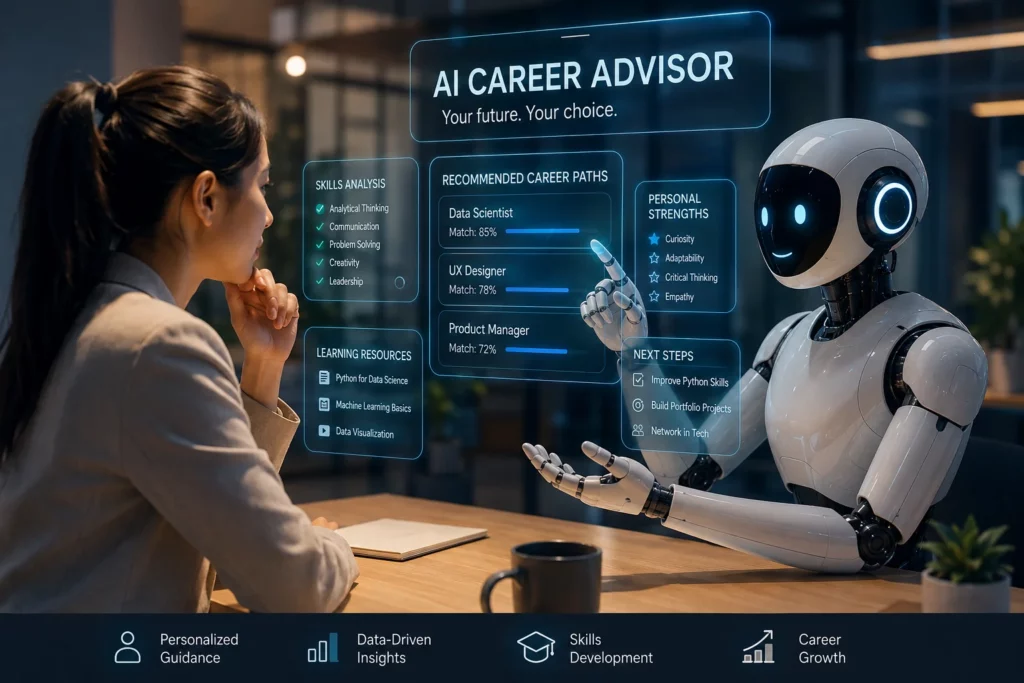
Picture two people applying for the same role. One spends a weekend rewriting their CV by guesswork; the other runs it through an AI career advice tool that flags missing keywords and suggests three adjacent career paths in minutes. That gap is why AI-powered tools have moved from a novelty to something jobseekers rely on, alongside traditional counsellors, job boards and generic assessments, to explore career options, identify skills gaps, improve CVs and get personalised recommendations.
This shift brings real opportunity, but also real questions about accuracy, privacy, bias and how much judgement should stay in human hands. As AI works its way further into the labour market, understanding both its strengths and its limits matters for jobseekers and professionals alike.
What AI Career Advice Actually Looks Like
Traditional career advice often depends on a person’s education, work experience, interests and conversations with a career adviser. AI can process many of these factors rapidly and combine them with information about occupations, skills and labour-market trends.
AI-powered career platforms can analyse a person’s CV, identify existing skills and suggest roles that may be suitable. Some tools can also recommend courses or qualifications based on gaps between a person’s current capabilities and the requirements of their desired career.
This reflects a wider change in the labour market. The World Economic Forum’s Future of Jobs Report 2025 identifies AI and big data, technological literacy, creative thinking, resilience and lifelong learning among skills expected to become increasingly important through 2030.
For someone uncertain about their next career move, AI can therefore act as a useful starting point for exploring possibilities.
Personalised Guidance, Delivered Instantly
One of AI’s biggest advantages is its ability to provide personalised recommendations at scale. A human career adviser may only have limited time with each person, whereas an AI system can potentially analyse a CV, job descriptions and skills information almost instantly.
For example, a user could tell an AI system about their current experience and career ambitions. The system could then identify transferable skills and suggest several possible career paths. Someone working in customer service might discover that their communication, problem-solving and relationship-management skills could transfer into sales, account management, recruitment or customer success.
AI can also help people prepare for job applications. It can suggest improvements to a CV, identify keywords from job descriptions, generate interview questions and provide feedback on written responses.
Research from the OECD on AI and labour-market matching highlights the growing use of AI in recruitment and employment services, including CV analysis, job matching, chatbots and candidate sourcing.
Turning a Skills Gap Into a Concrete Plan
Career development is no longer simply about choosing one profession and remaining in it for decades. Technology and changing business needs mean that workers increasingly need to update their skills.
AI can help make this process more practical. Instead of simply telling someone that they need to “learn new skills”, an AI career tool could compare their current abilities with the skills frequently requested for a particular role.
This could produce a development plan, such as learning data analysis, improving digital literacy, developing project-management skills or gaining experience with particular software.
The approach is especially relevant as employers increasingly value technological and human skills together. The World Economic Forum reports that AI and big data are among the fastest-growing skill areas, while creative thinking, resilience, flexibility and lifelong learning are also becoming more important.
Widening Access to Career Support
Another major opportunity is accessibility. Professional career counselling can be expensive or unavailable, particularly for people who are unemployed, changing careers or living in areas with limited career-support services.
AI tools can provide basic guidance at any time and potentially in multiple languages. This could help people who might otherwise struggle to access career information.
However, AI should ideally complement rather than replace professional advisers. Career decisions can involve personal circumstances, emotions, financial pressures and ambitions that are difficult for an algorithm to understand fully.
When the Algorithm Inherits Old Biases
One of the biggest concerns surrounding AI career advice is bias.
AI systems learn from data, and that data can contain historical patterns of inequality. If an AI system uses biased information to recommend careers or rank candidates, it could unintentionally reproduce those patterns.
The OECD’s research on AI and employment warns that biased AI systems can potentially systematise and multiply existing forms of discrimination. In recruitment, bias can affect who sees job opportunities and how candidates are selected or ranked.
This means users should not automatically assume that an AI-generated career recommendation is objective simply because it comes from a computer.
What Happens to Your Personal Data
Career advice can involve highly personal information, including employment history, education, salary expectations, career ambitions and sometimes personality characteristics.
Sharing this information with an AI system creates privacy considerations. Users should understand what information a service collects, how it is stored and whether it may be used for other purposes.
The OECD has identified privacy, transparency, accountability and discrimination as important risks associated with AI in the workplace.
People should therefore be cautious about uploading sensitive personal information to unfamiliar AI platforms.
Confident Answers Aren’t Always Correct Ones
Another limitation is accuracy. AI can produce confident-sounding recommendations that are incomplete, outdated or simply unsuitable for a particular individual.
A career recommendation might look logical based on someone’s stated skills while ignoring factors such as workplace culture, location, personal values or long-term ambitions.
There is also a danger of becoming too dependent on automated recommendations. Career development is ultimately a human decision. AI can identify possibilities, but it cannot determine what makes a career meaningful to an individual.
The OECD’s research on AI and work similarly emphasises that AI offers significant benefits while creating risks involving automation, privacy, bias, discrimination and transparency.
Where This Technology Goes From Here
AI is likely to become an increasingly common career-development tool. Future systems may combine personal skills profiles with constantly changing labour-market data to provide more dynamic recommendations.
Instead of simply asking, “What job should I do?”, people may use AI to explore questions such as: “Which skills should I develop next?”, “What careers could I transition into?” or “How can I remain employable as my industry changes?”
The most effective approach will probably combine AI’s ability to process information quickly with human judgement, empathy and experience.
AI can make career advice more personalised, accessible and data-driven, but it should not become the final authority over someone’s professional future. Used responsibly, it can act as a powerful career companion — helping people discover opportunities, understand their strengths and prepare for a changing world of work.
Read – AI in Recruitment: Opportunities and Challenges
Read – AI in Personal Assistants: Opportunities and Challenges
Sharing Is Caring