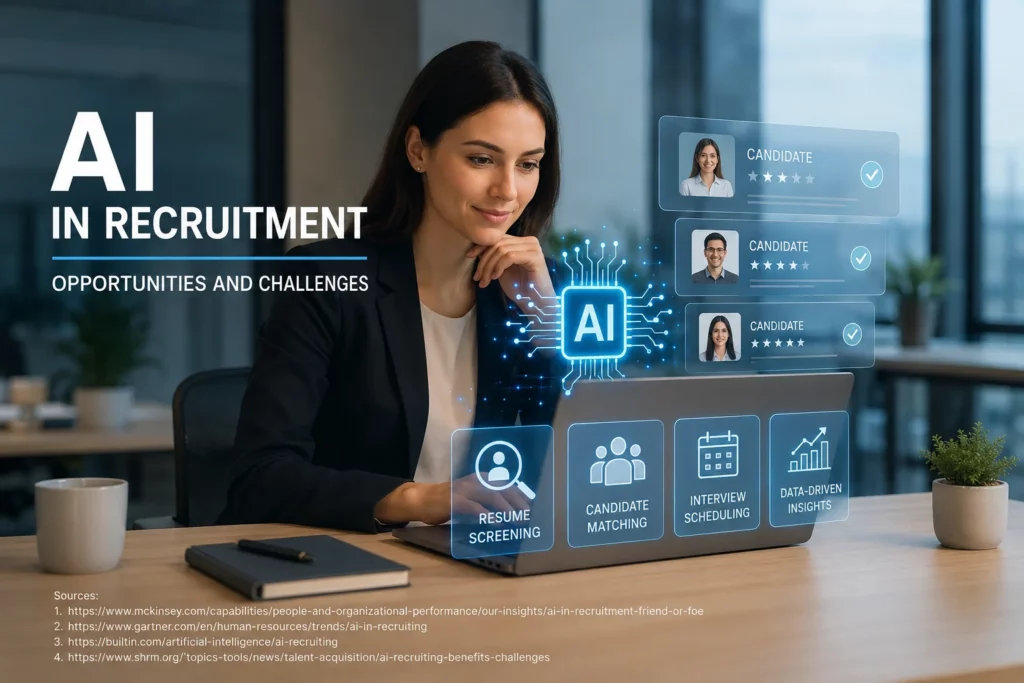
Artificial intelligence is changing the way companies find, evaluate and hire talent. From automated CV screening to AI-powered interviews and candidate matching, recruitment teams increasingly have access to tools that can process large volumes of information in a fraction of the time required by humans. As businesses face competitive labour markets and growing numbers of applications, AI offers an opportunity to make recruitment faster, more scalable and potentially more data-driven.
However, the use of AI in hiring also raises important questions. Algorithms can reproduce biases contained in historical data, candidates may not understand how decisions are made, and employers must consider privacy, accessibility and discrimination risks. The future of AI in recruitment is therefore unlikely to be about replacing recruiters entirely. Instead, the greatest opportunity may lie in combining artificial intelligence with human judgement.
How AI Is Being Used in Recruitment
AI can support almost every stage of the recruitment process. Recruiters can use AI-powered systems to write job descriptions, identify potential candidates, screen CVs, schedule interviews and analyse candidate information. Generative AI can also help recruiters communicate with applicants and create personalised messages.
Automated screening is particularly attractive to large organisations. When hundreds or thousands of people apply for a position, recruiters can struggle to review every application consistently. AI can analyse CVs against predefined criteria and help identify candidates whose experience or skills appear relevant.
AI can also contribute to skills-based recruitment. Rather than focusing exclusively on degrees, job titles or years of experience, organisations can use technology to identify specific capabilities that are relevant to a role. The World Economic Forum’s research on skills-based hiring highlights how organisations are increasingly looking beyond traditional credentials and focusing on the skills required for future roles.
Opportunities:
Faster and More Efficient Hiring
One of the biggest advantages of AI is efficiency. Recruitment involves many repetitive administrative tasks, including sorting applications, sending routine communications and arranging interviews. Automating some of these activities allows recruiters to spend more time on higher-value work.
For businesses recruiting at scale, this can be particularly valuable. AI can process large datasets quickly, helping organisations move candidates through early stages of recruitment without requiring recruiters to manually review every application.
This does not necessarily mean that recruiters become less important. Instead, their role can shift towards interviewing, relationship building, evaluating complex candidates and advising hiring managers.
Better Skills Matching
Traditional recruitment can sometimes place too much emphasis on a candidate’s previous job titles or educational background. AI creates opportunities to analyse skills and experience in more detailed ways.
This could help employers identify candidates who might otherwise be overlooked. Someone changing careers, returning to work or coming from a non-traditional educational background may have valuable transferable skills that are not immediately obvious from a conventional CV.
AI can also help employers understand changing workforce requirements. The World Economic Forum’s Future of Jobs Report 2025 identifies AI and big data, networks and cybersecurity, and technological literacy among the fastest-growing skills, while analytical thinking and human capabilities such as resilience and collaboration remain highly important.
Challenges:
Algorithmic Bias
Perhaps the biggest concern surrounding AI recruitment is bias. An AI system learns from data, and if that data reflects historical discrimination or unbalanced hiring patterns, the resulting system can potentially reproduce those problems.
This means AI is not automatically objective simply because a computer is making the assessment. An algorithm could unintentionally favour certain educational backgrounds, career histories or other characteristics because of patterns present in its training data.
The issue is serious enough that regulators have specifically addressed technology-assisted hiring. The U.S. Equal Employment Opportunity Commission states that employers cannot use recruitment practices that discriminate against protected groups. Its strategic enforcement plan also specifically identifies the use of artificial intelligence and machine learning in recruitment and hiring as an area requiring attention.
Employers therefore need to test recruitment systems regularly rather than assuming that an AI tool is inherently fair.
Lack of Transparency
Another concern is the “black box” problem. Candidates may not know why an AI system rejected their application or ranked another candidate more highly.
If recruiters cannot clearly explain how an automated recommendation was produced, it becomes difficult to challenge mistakes. This can damage candidate trust and create reputational problems for employers.
Transparency becomes especially important when AI is used for consequential decisions. Organisations should understand what their systems evaluate, what data they use and where human intervention remains possible.
Privacy and Data Protection
Recruitment involves sensitive personal information. CVs can contain employment histories, contact details, educational records and other personal data. AI systems may process large quantities of this information, creating additional privacy and security considerations.
Companies need clear policies around how candidate data is collected, stored, shared and deleted. They should also understand whether information submitted to an external AI service may be used for other purposes.
Responsible AI recruitment therefore requires more than choosing an impressive technology platform. Businesses need appropriate governance, security controls and data-handling practices.
The Importance of Human Oversight
The most effective approach is likely to be human-AI collaboration. AI can handle repetitive analysis and help recruiters identify patterns, but people remain essential when decisions involve context, communication, empathy and judgement.
The World Economic Forum has highlighted the importance of human oversight in AI-assisted recruitment, arguing that recruiters still play an important role in areas such as communication, cultural considerations and nuanced candidate evaluation.
Recruiters should therefore treat AI recommendations as inputs rather than unquestionable decisions. Human review can catch errors, challenge potentially biased recommendations and ensure that candidates are evaluated as individuals.
The Future of AI in Recruitment
AI is likely to become an increasingly important part of recruitment as organisations look for faster and more effective ways to compete for talent. Its ability to analyse information, automate repetitive work and support skills-based hiring presents significant opportunities.
At the same time, employers must recognise that efficiency cannot come at the expense of fairness or trust. Bias, privacy, transparency and accountability will remain central concerns.
Ultimately, AI should enhance recruitment rather than remove the human element from it. Companies that combine intelligent automation with strong governance and meaningful human oversight will be better positioned to use AI responsibly. The goal should not simply be to hire faster, but to make better-informed, fairer and more inclusive hiring decisions.
Read – AI in Personal Assistants: Opportunities and Challenges